
In the history of technology, 2024 will be remembered as the year of the “Chatbot,” but 2026 is officially the year of the “Agent.” We have moved past the era of Large Language Models (LLMs) that simply talk to us. We are now in the era of Agentic AI where autonomous systems that can plan, reason, and act across the digital world.
This shift goes far beyond security.

Prompts are becoming obsolete as goal-driven agents take control across industries.

👉 Dive into why agentic AI is replacing prompt-based systems in 2026.
However, as AI gains the ability to act on our behalf, it also gains the ability to impersonate us. Voice deepfakes have become so sophisticated that they can bypass 90% of traditional security systems. This has created a “crisis of trust” in digital identity.
To solve this, a new alliance has formed in the cybersecurity world: The Triad of Agentic Security. This guide explores the two pillars of this triad like Pindrop and Anonybit and how they use Agentic AI to secure our voices and identities.
What is Agentic AI? (The Core Engine)
Before we look at the companies, we must understand the engine driving them. Agentic AI is a paradigm shift in artificial intelligence.
From Passive to Proactive
Traditional AI (like the early versions of ChatGPT) followed a Prompt-Response model. You asked a question; it gave an answer. If you wanted to book a flight, you had to ask the AI for options, then you had to go to the website and click “Buy.”
Agentic AI operates on a Goal-Action model. You tell the agent: “I need to be in London on Tuesday for under $500.” The agent:
- Reasons: It looks at your calendar and preferences.
- Plans: It breaks the task into steps (Search → Compare → Verify Passport → Buy).
- Acts: It uses “tools” (APIs and browsers) to execute the purchase.
- Self-Corrects: If the flight sells out during the process, it goes back to step one and finds a new one without asking you.
Curious how today’s most powerful AI agents actually stack up?
We tested and ranked the leading AI agents of 2026  from security-focused systems to fully autonomous enterprise operators.
👉 See which AI agents are worth trusting (and which aren’t).
Why It’s Dangerous for Identity
In 2026, the same “Agentic” power is being used by hackers. They deploy Fraud Agents that can:
- Call a bank’s automated system.
- Use a deepfake of your voice to pass voice biometrics.
- Navigate the phone menu autonomously.
- Transfer money to a shell account.
This is why we need Agentic Defense security that is as smart and fast as the attackers.
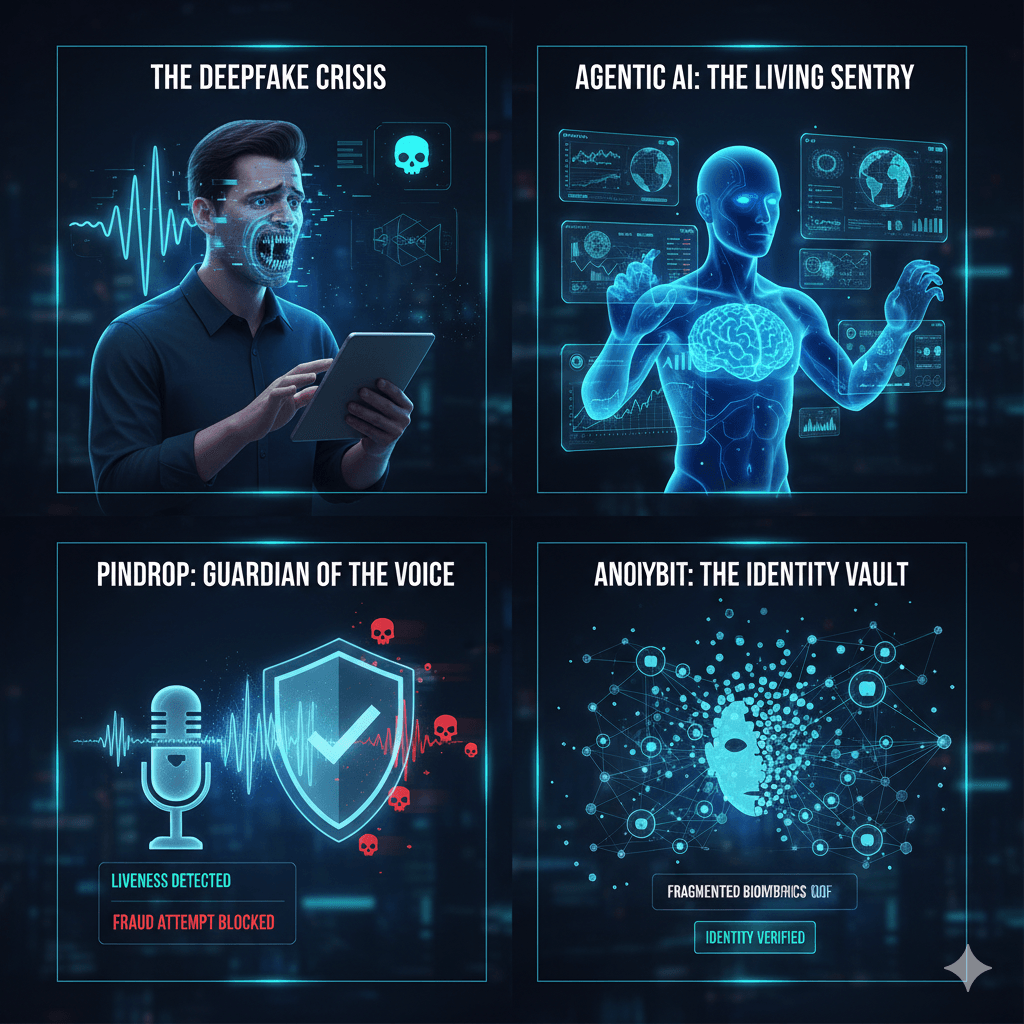
Pindrop: The Guardian of the Voice
Pindrop has long been the leader in voice security, but in 2026, they have evolved from a “filter” into a “Living Security Agent.” Pindrop’s mission is to solve the most pressing problem of the decade: The Deepfake Crisis.
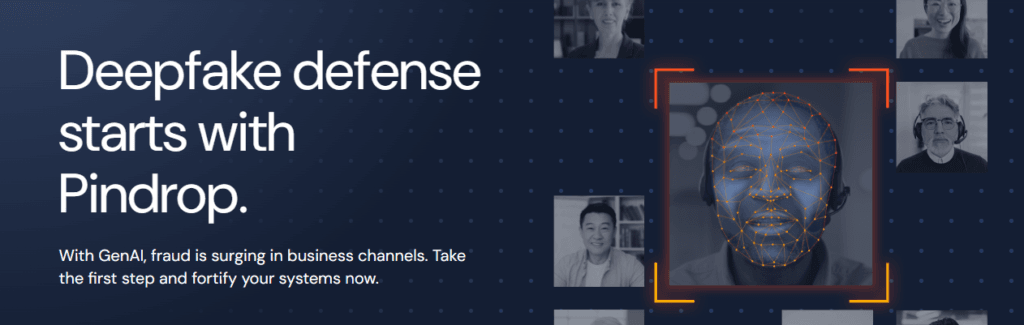
How Pindrop Uses Agentic AI (Pindrop Pulse)
Pindrop doesn’t just look for a “match” between your voice and a recording. In the Agentic Era, Pindrop uses Liveness Detection driven by an autonomous reasoning engine.
1. Real-Time Acoustic Analysis
When a call comes into a contact center, Pindrop’s agent begins an “Inquiry.” It analyzes over 1,300 acoustic features simultaneously:
- The “Lungs” Test: It checks for “spectral tilt” and air-pressure patterns. A human lung pushing air through a throat creates a different sound wave than a digital speaker or a text-to-speech (TTS) engine.
- Network Metadata: It looks at the “Phoneprinting” technology. Does the digital signal match the cellular tower it claims to be coming from?
- Synthetic Artifacts: AI-generated voices often leave “millisecond-level” delays or robotic cadence that the human ear misses but Pindrop’s agent flags in real-time.
2. The Decision Loop
Pindrop’s AI Agent doesn’t just give a “Yes/No.” It provides a Risk Score that evolves during the conversation.
- Observation: The caller sounds like “John Doe.”
- Reasoning: The voice matches, but the background noise sounds like a generic office loop, not John’s usual quiet home.
- Action: The agent silently triggers a “Step-Up Authentication” (asking the user for a biometric check via their phone) without the human bank teller even needing to intervene.
The Impact: Killing the “KBA”
Because of Pindrop, the 2026 contact center is faster. We have finally moved away from Knowledge-Based Authentication (KBA) those annoying questions like “What was the name of your first pet?” Hackers already know the answers to those. Pindrop allows companies to authenticate a user in under 5 seconds just by the sound of their voice.
Anonybit:The Architect of Private Identity
If Pindrop is the “Detective” listening to the voice, Anonybit is the “Vault” protecting the identity data.
In the past, biometric data (your face scan, your fingerprint) was stored in a central database. This was a “Honeypot”. If a hacker broke in, they got everything. Anonybit changed the game with Decentralized Biometrics.
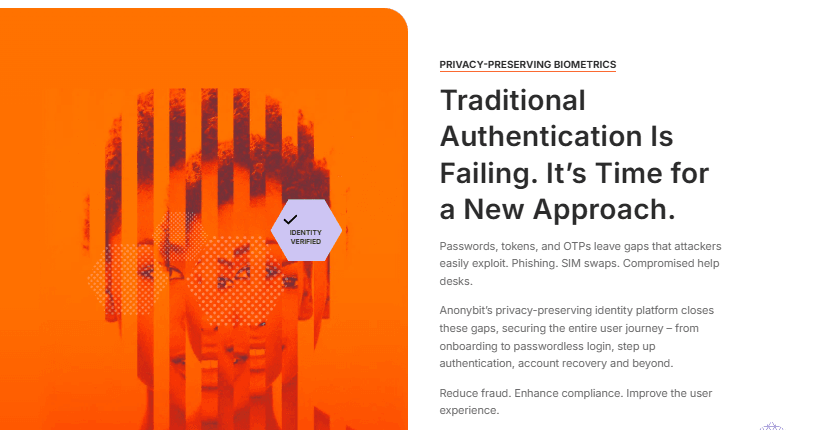
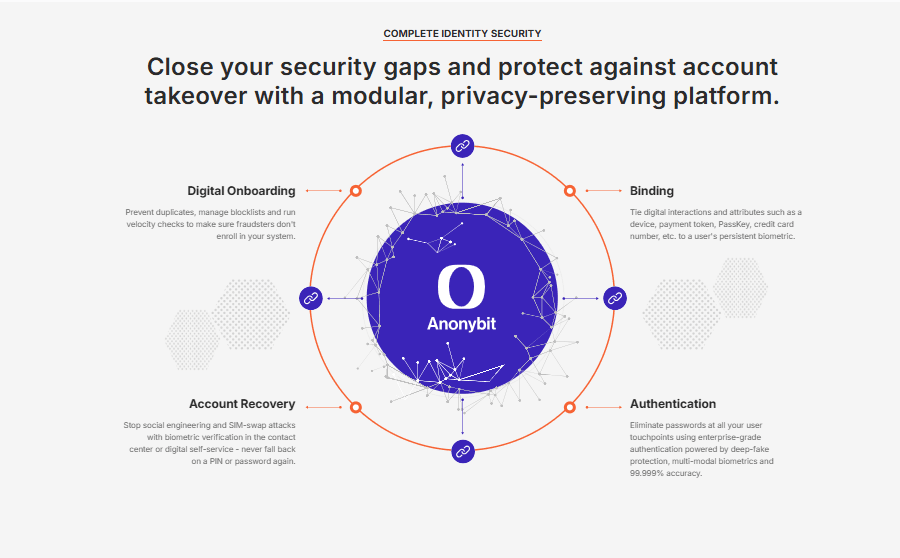
The Anonybit “Puzzle” Philosophy
Anonybit’s Agentic AI manages the Circle of Identity. Instead of storing your face in a file, it uses a process called Biometric Fragmentation.
- Fragmentation: When you enroll, Anonybit’s agent breaks your biometric data into thousands of tiny, encrypted pieces (bits).
- Decentralization: These bits are scattered across a global network of “nodes.” No single server has enough information to “see” your face or “hear” your voice.
- Zero-Knowledge Proofs (ZKP): When you try to log in, the Anonybit Agent acts as an orchestrator. It queries the nodes: “Does the bit you have match this specific part of the new scan?”
- The Answer: The nodes say “Yes” or “No” without ever sending the actual data back. The identity is verified, but the biometric data never exists as a whole image anywhere in the world.
Agentic AI for “KYA” (Know Your Agent)
In 2026, Anonybit has introduced KYA (Know Your Agent).
Since AI Agents are now performing transactions for us, we need to prove that our agent is authorized. Anonybit binds your biometric identity to your AI Agent.
- Before your “Travel Agent” buys a $2,000 flight, Anonybit triggers a “Heartbeat Check.” * You give a quick face-scan on your phone.
- Anonybit issues a Cryptographic Token to your agent.
- The agent uses that token to prove to the airline: “I am acting with the human’s permission.”
Pindrop vs. Anonybit:A Comparative Analysis
While they both use Agentic AI, they solve different parts of the security puzzle.
| Feature | Pindrop | Anonybit |
| Primary Domain | Voice & Call Center Security | General Identity & Multi-modal Biometrics |
| Main “Enemy” | Voice Deepfakes & Social Engineering | Centralized Databases & Identity Theft |
| Core Technology | Phoneprinting® & Liveness Detection | Biometric Fragmentation & ZKP |
| Agentic Role | Proactive “Listener” and Fraud Sentry | Decentralized Identity “Orchestrator” |
| Data Storage | Secured Voice Profiles | No Centralized Storage (Fragmented) |
| Key Use Case | Banking IVR and Customer Support | App Logins, Payments, and KYA |
How They Work Together
In a “Perfect Security Stack,” a company uses both.
- Pindrop ensures the person on the phone is a real human and not a deepfake.
- Anonybit ensures that the identity being claimed is protected by a decentralized vault that can’t be hacked.
Security agents don’t work alone and neither should yours.

Learn how to design and deploy a coordinated multi-agent team using CrewAI, with real workflows for monitoring, decision-making, and response.

👉 Build your own multi-agent system step by step.
The Business Case for Agentic Security
Why are enterprises spending billions on these tools in 2026? Because the ROI (Return on Investment) is undeniable.
1. Cost Reduction
Traditional fraud costs companies billions. But there’s a hidden cost: Friction. * Every time a customer forgets their password or fails a security question, it costs a bank roughly $15–$25 per call to have a human reset it.
- Agentic security allows for Passive Authentication. The user doesn’t have to do anything; the agents verify them in the background. This reduces “Average Handle Time” (AHT) by an average of 45 seconds per call.
2. Eliminating the “Honeypot” Risk
Under regulations like GDPR (Europe) and CCPA (California), losing customer biometric data results in massive fines (often 4% of global revenue). By using Anonybit’s decentralized model, companies can tell regulators: “We don’t actually store biometric data.” This virtually eliminates the risk of a catastrophic data breach.
3. Scaling for the “Agentic Economy”
By 2027, it is predicted that 50% of all customer service interactions will be Agent-to-Agent. If your company doesn’t have a secure way for an AI to prove it represents a human, you won’t be able to participate in the automated economy.
Challenges and Ethical Considerations
We cannot talk about Agentic AI without addressing the risks.
1. The “Black Box” Problem
Agentic AI makes its own decisions. If Pindrop’s agent blocks a legitimate customer (a False Positive), why did it do it? In 2026, there is a massive push for Explainable AI (XAI). Companies must be able to audit the “Reasoning” of the agent to ensure it isn’t being biased against certain accents or speech patterns.
2. Memory Poisoning
A new threat in 2026 is Memory Poisoning. If an attacker can interact with an AI Agent over a long period, they might slowly “teach” it to trust a fraudulent voice. This is why “Continuous Authentication” is vital—the agent must re-verify the identity frequently, not just at the start.
3. Privacy vs. Surveillance
As Pindrop and Anonybit become more “invisible,” we must ensure they don’t turn into surveillance tools. Both companies have taken a Privacy-by-Design approach, ensuring that data is only used for authentication and never for tracking a user’s personal life.
FAQs: Everything You Need to Know
Q: Is “Agentic AI” just a new buzzword for “Automation”?
A: No. Automation follows a script (If X, then Y). Agentic AI has Reasoning and Agency. It decides how to solve a problem and can change its plan if the environment changes.
Q: Can a deepfake ever beat Pindrop in 2026?
A: It is an “Arms Race.” While Pindrop catches 99.2% of deepfakes, attackers are always trying new things. However, because Pindrop’s agent learns from every call globally, it usually identifies a new attack method within hours of it appearing.
Q: Does Anonybit store a backup of my face “just in case”?
A: No. That is the point of their technology. There is no “master key” or “master image.” If Anonybit themselves were hacked, the hackers would find billions of useless “fragments” that can’t be put back together.
Q: Do I need to be a tech expert to use these?
A: For the end-user, this technology is invisible. You just talk or look at your phone. For businesses, these are now “Low-Code” integrations that can be plugged into existing systems like Salesforce or AWS.
Conclusion: The New Standard of Trust
The “Agentic Shift” is the biggest change in cybersecurity since the invention of the firewall. We can no longer rely on humans to spot fakes, and we can no longer rely on central databases to keep us safe.
Pindrop and Anonybit represent the two halves of the future. Pindrop provides the Intelligence to know what is real, and Anonybit provides the Architecture to keep what is real private.
As we move deeper into 2026, “Agentic Security” will become as common as the lock on your front door. It is the only way to ensure that in a world full of AI clones, the “Real You” is always recognized.