
If you’ve been exploring AI tools for chatbots or automation, you’ve probably heard of Flow.ai.
It’s one of the most user-friendly platforms for building AI-powered conversational experiences without needing to write a single line of code.
Flow.ai helps businesses create chatbots for customer support, sales, or social media that sound natural and human. But in 2025, the world of AI chat platforms has expanded. Many new tools now offer similar or even better features, with smarter AI models, deeper integrations, and more affordable pricing.
So the big question is:
Is there another program like Flow.ai?
Absolutely. In fact, there are several great alternatives depending on your needs. Some are more advanced, some are simpler, and a few are completely free.
In this guide, we’ll explore what Flow.ai does, why people love it, its limitations, and the best AI chatbot tools like Flow.ai that can help you build smarter conversations in 2025 and beyond.
What Is Flow.ai?
Flow.ai is an AI chatbot platform that helps you design, train, and deploy bots for websites, apps, and messaging channels such as WhatsApp, Messenger, and Slack.

Here’s what makes it stand out:
- No coding required: You build chat flows visually with drag-and-drop tools.
- Multichannel integration: Connect your bot to websites, social media, and CRMs.
- Natural Language Understanding (NLU): Flow.ai’s AI can recognize user intent and reply in a conversational way.
- Team collaboration: Multiple people can build or test flows together.
- Analytics dashboard: Track how users interact with your chatbot.
Why Businesses Use Flow.ai
Businesses especially small to medium-sized ones that use Flow.ai because it’s:
- Simple to use
- Affordable compared to enterprise tools
- Powerful enough for real automation
Whether you’re running customer support or an e-commerce chatbot, Flow.ai gives you a balanced mix of simplicity, AI power, and collaboration.
Turn your creativity into conversations! Start creating your personalized chatbot on Chai AI and join the next wave of AI-powered social interaction.Why Look for Alternatives to Flow.ai?
Even though Flow.ai is excellent, there are reasons you might want to explore alternatives chatbot:
| Reason | Explanation |
| Pricing scalability | As you add more conversations or users, Flow.ai costs can rise quickly. |
| Limited AI customization | You can’t always fine-tune the model deeply or use your own datasets. |
| Fewer integrations | Competing platforms now support more tools like HubSpot, Shopify, or Zapier. |
| Advanced analytics | Some newer tools provide deeper user insights or behavior tracking. |
| Design flexibility | Other builders offer richer design tools and adaptive conversation flows. |
So if you’re scaling your automation strategy, it makes sense to explore other chatbot platforms, some of which can do even more than Flow.ai.
Stop searching, start creating!

Explore AgentX to design your own intelligent chatbot platform today.
Top Alternatives to Flow.ai in 2025
Let’s look at the best Flow.ai alternatives that are popular in 2025.
These platforms combine user-friendly design, strong AI, and affordable pricing.
1. Manychat: The Social Media Chatbot Pro
Best for: Social media automation and marketing.
Manychat is a powerful alternative if your focus is on Instagram, Facebook, or WhatsApp automation. It helps you create conversational flows that boost engagement and drive sales.

Key Features:
- Drag-and-drop chatbot builder
- Auto-reply to DMs and comments
- Integration with Shopify and Google Sheets
- AI text suggestions for messages
- Free tier with basic automation
Why It’s Like Flow.ai:
Both tools are no-code and intuitive, but Manychat is better for social marketing while Flow.ai is more multi-channel.
2. Tidio: Customer Service Meets AI
Best for: Customer support chatbots and live chat.
Tidio combines AI chatbot automation with real-time human chat, giving you the best of both worlds. It’s perfect for websites that need instant customer response.
Key Features:
- Integrates with WordPress, Shopify, and Wix
- Visual drag-and-drop flow editor
- AI-powered “Lyro” chatbot that learns from conversations
- Shared inbox for human agents
- Free plan available
Why It’s Like Flow.ai:
Tidio also focuses on simplicity and automation but adds live chat for human backup that ideal for e-commerce sites.
3. Botpress: The Developer’s Choice
Best for: Advanced customization and enterprise needs.
If you love open-source software and flexibility, Botpress is a top Flow.ai alternative. It lets you train, host, and control your chatbot logic.
Key Features:
- Open-source, self-hosted chatbot framework
- Advanced NLU and GPT-based modules
- Custom integrations and APIs
- Multi-language support
- Scalable for large enterprises
Why It’s Like Flow.ai:
Both let you build natural conversations, but Botpress offers more control and perfect for technical teams.
4. Chatfuel: AI Automation for Businesses
Best for: Facebook, Instagram, and website automation.
Chatfuel is a well-known AI chatbot tool that helps businesses automate customer conversations and lead generation.
Key Features:
- Smart automation templates
- Integrates with WhatsApp, Telegram, and Messenger
- AI intent detection
- Analytics for engagement and performance
- Free and paid versions
Why It’s Like Flow.ai:
Chatfuel is one of the original no-code AI chatbot builders just like Flow.ai but now includes better templates for marketing.
5. Landbot: Design-First Conversational Builder
Best for: Interactive website chatbots and lead generation.
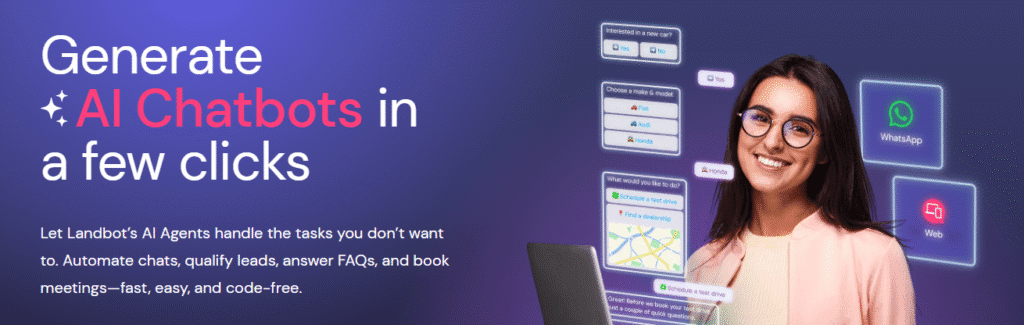
Landbot turns conversation design into a fun, visual experience. It lets you create beautiful, branded chatbot interfaces.
Key Features:
- Visual flow builder (even prettier than Flow.ai)
- Web and WhatsApp bots
- Conditional logic and rich UI elements
- Analytics and CRM integrations
- Free tier for basic users
Why It’s Like Flow.ai:
Landbot focuses on design and engagement, making your bot experience feel human and appealing.
Comparison Table: Best Flow.ai Alternatives in 2025
| Tool Name | Best For | AI Features | Ease of Use | Pricing | Free Plan |
| Flow.ai | All-round automation | NLU, drag-and-drop builder | Very Easy | $$ | Yes |
| Manychat | Social media bots | Auto-DM, templates | Easy | $$ | Yes |
| Tidio | Customer service | AI “Lyro” chatbot | Very Easy | $$ | Yes |
| Botpress | Developer control | GPT modules, APIs | Medium | $$$ | No |
| Chatfuel | Business automation | AI intent detection | Easy | $$ | Yes |
| Landbot | Website engagement | Visual flow, logic | Very Easy | $$ | Yes |
How These Tools Compare to Flow.ai
If you’re switching from Flow.ai, here’s how the alternatives stack up:
- Ease of Use: Flow.ai, Tidio, and Landbot are perfect for beginners.
- Customization: Botpress leads with deep technical control.
- Marketing Integration: Manychat and Chatfuel excel at connecting to social platforms.
- Pricing Flexibility: Tidio and Landbot offer great free tiers for startups.
- Scalability: Botpress and Chatfuel handle large-scale operations well.
In short, your choice depends on what matters most; simplicity, integrations, or advanced AI control.
Key Features to Look For in a Flow.ai Alternative
When choosing an AI chatbot platform, make sure it has:
1. Drag-and-Drop Builder
You shouldn’t need to code. The tool should let you create chatbot logic visually.
2. Multichannel Support
Your chatbot should work on your website, WhatsApp, Facebook, or email.
3. Natural Language Understanding (NLU)
Modern AI should understand intent, tone, and context like Flow.ai or ChatGPT-based bots.
4. Integrations
Look for CRM, Zapier, or Google Sheets connections for smoother workflows.
5. Analytics
Tracking user journeys helps you measure and improve engagement.
6. Affordable Pricing
Free plans are great for testing, but make sure paid plans scale well with your business.
AI in Chatbots: The AI Revolution
AI chatbot tools have evolved rapidly in 2025. New technologies such as GPT-5, multimodal AI, and contextual memory are making bots more human than ever.
Flow.ai alternatives now offer:
- Real-time learning: bots can adapt during chats
- Voice-enabled conversations
- Emotion detection: understanding tone of voice or sentiment
- Smart data sync: connecting with CRMs and analytics automatically
These improvements mean any small business can now build a human-like chatbot that answers questions, sells products, or schedules appointments without hiring a big tech team.
Using AI Chat Tools to Boost Sales
Let’s say you run an online fashion store. You can:
- Use Manychat to respond instantly to DMs on Instagram.
- Add Tidio to your website for live chat support.
- Set up Flow.ai or Landbot to guide customers through a size or color quiz.
The result?
More engagement, faster responses, and higher conversions, all automated.
Expert Tip: Combine Tools for Maximum Impact
You don’t always have to choose just one.
For example:
- Use Flow.ai for website automation.
- Add Manychat for social media interactions.
- Connect them via Zapier or your CRM.
This gives you a unified automation ecosystem that feels seamless across all platforms.
Experience the power of ChatGPT Agent Mode firsthand.FAQ: Flow.ai and Its Alternatives
Q1: Is Flow.ai still worth using in 2025?
Yes. It’s a great all-round chatbot builder, especially for small businesses that want simple, visual design and reliable automation.
Q2: Which Flow.ai alternative is best for social media?
Manychat is best for Instagram, Facebook, and WhatsApp automation.
Q3: What’s the most beginner-friendly alternative?
Tidio and Landbot are the easiest for non-technical users.
Q4: Can these tools integrate with ChatGPT or OpenAI APIs?
Yes. Botpress, Chatfuel, and even Flow.ai now support GPT-based connections.
Q5: Are these tools safe for business data?
All major chatbot platforms follow GDPR and standard data security practices. Always review their privacy policies before connecting sensitive data.
Conclusion: Choosing the Right AI Chatbot Tool for You
Flow.ai remains one of the best tools for creating AI-powered chatbots, but it’s no longer the only one.
Several alternatives like Tidio, Manychat, Landbot, Chatfuel, and Botpress offer equal or even greater flexibility, depending on what you need.
No matter which you choose, the goal is the same:
To create smarter, more natural, and more human conversations with your audience that powered by AI.
Ready to explore AI chatbot tools beyond Flow.ai?