
When exploring conversational artificial intelligence, most users expect a universal multimedia powerhouse. You type a prompt, and out pops a photo-realistic landscape, a marketing banner, or a cartoon mascot. While competitors like OpenAI’s ChatGPT and Google Gemini make image creation effortless, a persistent question echoes across tech forums: can claude generate images?
The short answer is no, Claude cannot directly generate raster images (like PNGs or JPEGs) from text prompts the way DALL-E 3 or Imagen do. Anthropic has intentionally built Claude to excel at deep reasoning, coding, document analysis, and text generation rather than visual synthesis.
In this comprehensive guide, we examine why Claude lacks a native image generation tool, how its powerful vision and Artifacts features compensate, and which platforms stand out when you need claude ai image generation alternatives.
The Core Question: Can Claude Generate Images Like ChatGPT or Gemini?
If you log into Claude.ai expecting to type “Generate an image of a cybernetic tiger in a neon forest,” you will not receive a visual graphic. Instead, Claude will politely explain its current design scope.
To understand how major conversational models stack up, let’s look at a direct feature comparison:
| AI Assistant / Platform | Native Image Generation | Image Analysis / Vision | Code & SVG Rendering | Primary Design Focus |
| Anthropic Claude | ❌ No | ✅ Yes (Advanced) | ✅ Yes (via Artifacts) | Reasoning, coding, analysis, and safety |
| OpenAI ChatGPT (Plus) | ✅ Yes (DALL-E 3) | ✅ Yes | Limited code artifacts | General assistant & multimedia |
| Google Gemini | ✅ Yes (Imagen) | ✅ Yes | Limited | Multimodal integration & search |
As the table shows, while can chatgpt generate images and can gemini generate images yield immediate visual outputs, Claude approaches media differently. It can analyze images you upload, extract data from charts, and even write code to render geometric designs, but it cannot paint pixels from scratch.
Why Doesn’t Claude Have a Native Image Generator?
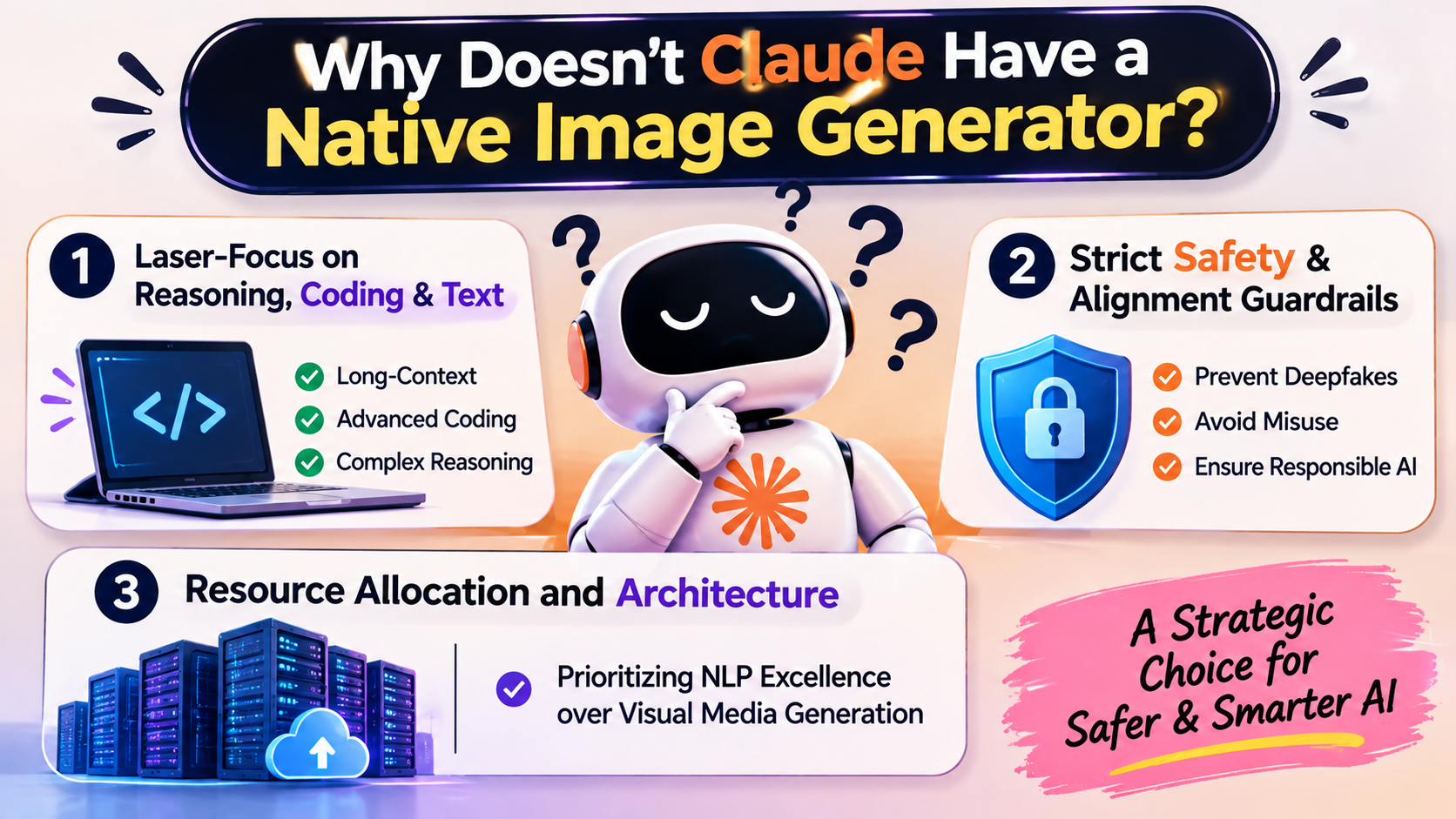
Many tech enthusiasts wonder why Anthropic has left image generation off its roadmap while rivals race ahead. Several strategic, technical, and ethical factors explain this decision:
1. Laser-Focus on Reasoning, Coding, and Text
Anthropic positions Claude as an enterprise-grade cognitive partner. By directing computational resources toward long-context windows, advanced coding synthesis (via Claude 3.5 Sonnet), and complex mathematical reasoning, Claude maintains superior reliability in professional workflows where image rendering is unnecessary.
2. Strict Safety and Alignment Guardrails
Image generation models carry significant risks regarding deepfakes, copyright infringement, and inappropriate content moderation. Restricting output modalities to text, data structures, and code allows Anthropic to maintain stringent safety alignment without managing the complex content filters required for public image synthesis.
3. Resource Allocation and Architecture
Building and maintaining state-of-the-art diffusion models (like Midjourney or DALL-E) requires distinct neural architectures and massive GPU infrastructure. Anthropic has historically prioritized NLP (Natural Language Processing) excellence and safety research over visual media generation.
How Claude Handles Visuals: Vision and Artifacts Workarounds
Even though can claude generate images online yields a negative answer for direct image creation, Claude possesses robust visual and creative capabilities that bridge the gap.
1. Advanced Image Analysis (Vision)
While Claude cannot output images, it is an elite consumer of them. You can upload architectural blueprints, UI wireframes, handwritten notes, or financial charts. Claude can inspect the visual data and:
- Convert UI sketches directly into clean HTML/CSS code.
- Analyze data trends from static graphs and summarize them in markdown tables.
- Review photography composition and offer expert critique.
2. Generating Graphics via Claude Artifacts (SVG & HTML)
If you ask Claude to create a visual asset like a flowchart, a banner design, or a logo concept, it leverages Claude Artifacts to write Scalable Vector Graphics (SVG) or HTML/CSS code.
User Prompt: “Design a minimalist vector icon for a tech startup using SVG code.”
Claude generates clean, editable vector code in a side panel that renders directly in your browser. You can inspect, modify, and export the SVG file for use in design tools like Figma or Illustrator.
Which AI Can Generate Images? Top Alternatives in 2026
If your primary goal is visual creation, relying solely on Claude will leave you searching for external solutions. If you are asking which ai can generate images, several market leaders fill this exact niche:
- OpenAI DALL-E 3 (via ChatGPT): Best for conversational prompt adherence, rendering complex scenes, and embedding readable text into images.
- Google Imagen 3 (via Gemini): Excels at photorealism, lighting accuracy, and natural integration with Google Workspace.
- Midjourney (v6): The gold standard for cinematic artistic quality, fantasy art, and high-end conceptual design.
- Flux.1 (by Black Forest Labs): Exceptional open-weights image generator known for crisp typography and anatomical precision.
For users seeking a complete workflow, many professionals use Claude to write detailed creative prompts and storyboard outlines, then plug those prompts into Midjourney or DALL-E 3.
“While Claude cannot natively output raster images or video files on its own, its advanced reasoning and coding features open up fascinating creative possibilities. To see how you can leverage Claude for multimedia projects, check out our comprehensive guide on Can Claude Edit Videos for Free? The Complete AI Workflow Guide.”
Frequently Asked Questions (FAQs)
1. Can Claude generate images from text prompts?
No. Claude cannot directly output raster images like PNGs or JPEGs from text descriptions. It focuses on text, code, and document analysis.
2. Can Claude generate images like ChatGPT or Gemini?
Unlike ChatGPT (which uses DALL-E 3) and Gemini (which uses Imagen), Claude does not feature a built-in image generation tool. However, it can write SVG vector code and analyze uploaded images.
3. Can I use Claude to design websites or UI layouts?
Yes! While it cannot draw pictures, Claude’s vision and code capabilities allow it to look at wireframe sketches and generate fully functional frontend code (HTML, CSS, React) to bring UI concepts to life.
4. Is there any way to get images out of Claude?
Yes. You can ask Claude to generate SVG (Scalable Vector Graphics) code inside Artifacts. SVGs render visually in your browser and can be saved as vector image files.
5. Will Anthropic add image generation to Claude in the future?
Anthropic has not announced plans to release a native diffusion-based image generator, choosing instead to focus on enterprise reasoning, coding performance, and advanced multimodal analysis.