
The modern healthcare clinic is facing a “silent crisis.” Phones are ringing off the hook, front-desk staff are battling burnout, and patients are stuck on hold for an average of 11 minutes. In 2026, these inefficiencies don’t just cause frustration as they lead to a 20-30% loss in revenue due to missed appointments and administrative errors.
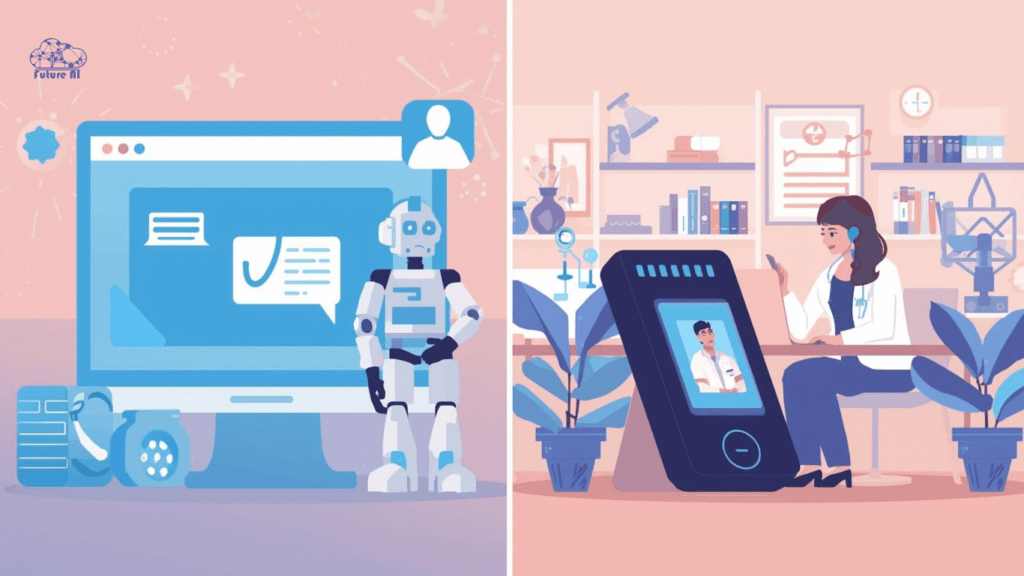
Enter the AI Voice Agents in Healthcare. Unlike the frustrating “Press 1 for Sales” menus of the past, these advanced digital assistants use natural language to talk, listen, and solve problems like a human teammate.
This guide explores how AI voice agents are transforming patient care, how to stay HIPAA-compliant, and how you can implement this technology to give your staff their time back.
What is an AI Voice Agent in Healthcare?
In 2026, we distinguish between “Old IVR” and “Modern AI Agents.” An AI Voice Agent is a software system that uses Generative AI to conduct fluid, human-like conversations over the phone.
How the “Brain” Works:
- Speech-to-Text (STT): The agent “hears” the patient, even with background noise or thick accents.
- Medical LLM: A Large Language Model trained on medical datasets understands context. If a patient says, “I have a pounding head,” the AI knows they mean a headache, not a literal hammer.
- Action Engine: The AI doesn’t just talk; it does. It checks your calendar, updates the EHR (Electronic Health Record), and sends confirmation texts.
Key Difference: A chatbot stays on your website. A Voice Agent lives on your phone lines, handling the 70% of routine calls that usually distract your medical assistants.
High-Impact Use Cases for Your Practice
Why are clinics adopting this so fast? Because it solves the “Monday Morning Rush.”
24/7 Appointment Management
AI agents never sleep. A patient can call at 2:00 AM on a Sunday to reschedule their Tuesday physical. The AI checks the live EMR (like Epic or Athena), moves the slot, and notifies the doctor instantly.

Automated Triage & Routing
AI can act as a “first responder.” By asking a few clinically-validated questions, the agent can determine if a patient needs an urgent nurse call-back or just a routine follow-up, reducing unnecessary ER visits by up to 25%.

Prescription Refills & Lab Notifications
Instead of a staff member spending 3 hours a day on the phone saying “Your results are normal,” the AI agent can securely verify the patient’s identity and deliver the message or process the refill request with the pharmacy.

The “Elephant in the Room”: HIPAA & Security
In healthcare, “Trust” is your most valuable asset. Standard AI tools like ChatGPT are not safe for patient data out of the box.
The HIPAA Checklist for 2026:
- The BAA (Business Associate Agreement): Never sign a contract with an AI vendor unless they sign a BAA. This legally binds them to protect your patient’s PHI (Protected Health Information).
- Encryption at Rest & In Transit: Every word the patient speaks must be encrypted the second it hits the “digital ear” of the AI. Minimum TLS 1.3 for data in transit and AES-256 for data at rest.
- Data Minimization: Top-tier agents in 2026 use “zero-retention” models, meaning they process the request and immediately delete the audio file once the data is safely written to the medical record.
Top AI Voice Platforms for Healthcare in Market Right Now
| Platform | Best For | Key Strength |
| Lumay SmartCall | Enterprise Systems | Handles 10,000+ concurrent calls; SOC2 & HITRUST certified. |
| Retell AI | Custom Development | Medical terminology ASR with 95%+ accuracy; fast API integration. |
| Hyro | Plug-and-Play Clinics | No-code builder; excellent at “Natural Language” scheduling. |
| Nuance (Microsoft) | Hospital Infrastructure | Deepest integration with clinical documentation (DAX). |
| Hippocratic AI | Safety-First Triage | Focused on clinically-safe “Nurse-like” interactions. |
How to Select the Right AI Voice Agent (Tool Guide)
Not all agents are created equal. Here is how the market looks in 2026:
| Tool Category | Best For | Top Examples |
| Enterprise/Hospital | Large networks with 10k+ calls | Lumay SmartCall, Nuance (Microsoft) |
| Clinic/SMB | Fast setup for local practices | Simbie AI, TriageLogic, Voiceoc |
| Developer/API | Building a custom, unique flow | Retell AI, Bland AI, OpenAI Realtime |
What to Look For:
- 95%+ Accuracy: Can it understand “metoprolol” vs. “metformin”?
- Barge-in Support: Can the patient interrupt the AI? (Crucial for a “human” feel).
- EHR Native Sync: Does it talk to Epic, Cerner, or AthenaHealth directly?
Voice AI improves communication as wearable AI improves outcomes. See how both technologies work together in AI Wearables: Your Health’s New Best Friend.
Implementation Step-by-Step
Don’t try to automate your whole clinic in one day. Follow this “Slow-is-Fast” approach:
- Step 1: The Audit. Track your calls for 3 days. What is the #1 reason people call? (Usually scheduling). Start there.
- Step 2: The Scripting. Work with your lead nurse to define the “Safety Guardrails.” For example: “If the patient says ‘chest pain,’ immediately transfer to the emergency line.”
- Step 3: The 25% Rollout. Route only 25% of your calls to the AI for the first week. Listen to the recordings (with permission) and see where the AI got confused.
- Step 4: Full Launch. Once you hit an 85% resolution rate, open the lines to 24/7 coverage.
Common Mistakes & Troubleshooting
The “Uncanny Valley”
Don’t try to trick patients into thinking the AI is a real person named “Susan.” Patients appreciate honesty. Say: “Hi, I’m the clinic’s AI assistant. I can help you book or change an appointment.”
Poor Handoffs
The biggest frustration is getting “stuck” with a robot. Always have a “Press 0 for a Human” option available at every second of the call.
Bad Audio Quality
If your clinic’s phone system is 20 years old, the AI won’t be able to “hear” clearly. Ensure you have a modern VoIP connection.
FAQ: Real Questions from Providers
Q: Will patients be mad they aren’t talking to a human?
A: Actually, 2026 data shows that 82% of patients prefer a 30-second call with an AI over a 10-minute wait for a human.
Q: Can the AI give medical advice?
A: No. You should program your AI to only provide “Approved Patient Education” (like “What time should I stop eating before my blood test?”) and never diagnose a condition.
Q: How much does it cost?
A: Most systems charge a flat monthly fee (starting around $350) plus a small fee per minute (about $0.15–$0.30). This is significantly cheaper than hiring a full-time staff member.
Conclusion: Giving Healthcare Back to Humans
The ultimate goal of an AI Voice Agent isn’t to remove people from healthcare as it’s to remove the paperwork from people. When an AI handles the scheduling and the refills, your front-desk staff can finally look a patient in the eye, offer a smile, and provide the human empathy that no machine can ever replicate.